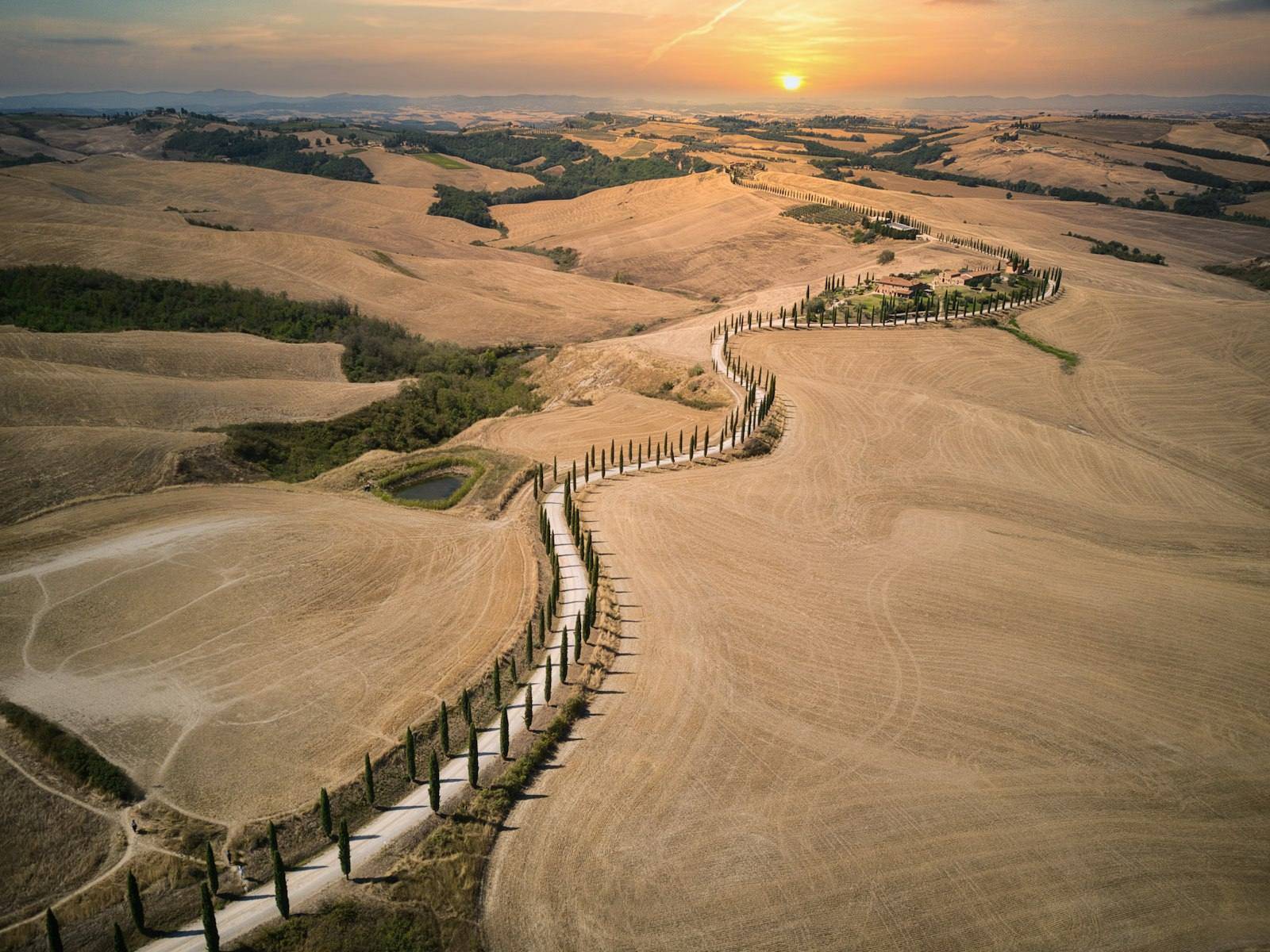
Tuscany behind the wheel.
Cypress avenues dropping into the valley. A hilltop winery no bus will ever reach. Val d'Orcia at sunset, when the last tourists have gone. All of this — only behind the wheel.
Cypress avenues dropping into the valley. A hilltop winery no bus will ever reach. Val d'Orcia at sunset, when the last tourists have gone. All of this — only behind the wheel.
You’ll fly or travel to Florence — the region’s main hub. From there a car is essential: Val d'Orcia, Montepulciano, San Gimignano and most of the wineries are not connected to the city by normal public transport. Without a car you’ll only see what’s within walking distance of the station.
Florence is the logical gateway to Tuscany. Direct flights via European hubs, Frecciarossa trains from Rome in 1.5 hours and from Milan in 2 hours, FlixBus from dozens of European cities. The most convenient way to compare all options on a single screen — trains, buses and flights in one search.
Compare tickets on Omio →More on when a train is cheaper than a plane and how not to overpay for tickets: trains and buses across Europe.
Tuscany is arranged so that the most beautiful things are deliberately hidden from those arriving by train alone. Val d'Orcia — the cypress hills printed on every postcard — is a valley with no railway. Montepulciano sits on a hilltop: one bus a day, the last one leaves at five in the afternoon. San Gimignano with its towers is reachable from Florence only with connections and half a day lost. Most Chianti and Montalcino wineries lie along dirt tracks — white gravel strade bianche where no taxi will venture.
Renting a car in Florence is convenient right at Peretola Airport (FLR) or at Santa Maria Novella station. Compare prices in advance — the difference between an aggregator and the airport counter can be double.
Compare cars on Discover Cars →Three tips that save money: choose a manual gearbox — it’s 20–30% cheaper than automatic and handles Tuscany’s narrow roads perfectly; add full coverage when booking online through an aggregator, not at the counter — the same policy in person costs three times more; check the car class — a compact hatchback is easier to park in medieval town centres than an SUV. A detailed breakdown of how not to overpay: how not to overpay for a rental.
If you already have a car, plan the route yourself: Florence — Chianti — Montalcino — Pienza — Montepulciano — San Gimignano — return. Five to seven days is perfectly comfortable for this. For those travelling without a car, or who want to add a storytelling guide to their self-drive trip, tours with transfers from Florence cover most of the highlights.
On how we choose tours and why not all guides are equally good: how we choose tours.
One practical detail: when driving Tuscany’s dirt roads, navigation is critical — many strade bianche are unsigned or lead to dead-end wineries. Installing an Airalo eSIM before you leave means maps work without roaming even on the most remote hillside.
May and September strike the ideal balance: warm but not scorching, with fewer tourists than in July–August. In May poppies and oleanders are in bloom; in September the grape and olive harvests begin. Summer (June–August) is very hot and parking in popular towns is a nightmare. April and October are also good, but some wineries operate on reduced hours.
A minimum of 5 days; 7–8 is comfortable. In 5 days you can realistically cover Florence, Chianti, Siena and one day in Val d'Orcia. A week adds Montalcino, Montepulciano, San Gimignano and a few “no-plan” days — those tend to be the most memorable. Fewer than four days means just Florence and one nearby excursion — the rest simply won’t fit.
Florence works better for most itineraries: Peretola Airport (FLR) is 20 minutes from the centre, and you can pick up a rental car right there. Pisa (PSA) is good if you’re flying with Ryanair or easyJet — a bigger airport, more flights, rental desks right in the terminal. By train to Florence: Frecciarossa from Rome in 1.5 hours, from Milan — in 2 hours. All options — trains, buses, flights — are convenient to compare in a single window.
Non-negotiable: Val d'Orcia — the heart of picture-postcard Tuscany, cypress hills and the villages of Pienza and Bagno Vignoni; Siena — the medieval Campo square and Duomo are better than Florence’s for sheer atmosphere; San Gimignano with its towers and Vernaccia white wine; Chianti — the vineyards between Florence and Siena, the best dirt roads and tastings. If there’s one more day: Montalcino (Brunello) and Montepulciano (Vino Nobile) — essential for wine lovers.
It depends on your itinerary. Florence — if you want a big city, museums and a quick transfer to the airport; downsides — traffic and expensive parking. Siena — a central hub for the whole region: Val d'Orcia, Montalcino and Chianti are equally close. An agriturismo in Chianti — the best option: a farmhouse or winery among the hills, free parking, breakfast made from the farm’s own produce and complete peace in the evenings. Agriturismo prices are often lower than city hotels of the same standard.
A compact hatchback — from €30–45 per day when booked in advance through an aggregator; at the airport counter the same car costs 1.5–2 times more. Full coverage insurance is much better value when added during online booking — in person it costs three times more. A manual gearbox is 20–30% cheaper than automatic and more practical on the region’s hilly roads. You can compare offers from dozens of companies at once on Discover Cars — the final price including insurance is shown with no hidden extras.
Florence, Siena and Pisa — yes, by train. But Val d'Orcia, Montepulciano, most Chianti wineries and the cypress-lined dirt roads are practically inaccessible without a car. The alternative — organised tours with transfers from Florence: they cover the major highlights, but the itinerary won’t be your own.
Manual isn’t compulsory, but it’s better value: Tuscany has hilly roads that suit short gears, and manual is 20–30% cheaper. For holders of a standard EU driving licence, no additional translation or IDP document is required in Italy.
The best regions for tasting — Chianti Classico, Montalcino (Brunello) and Montepulciano (Vino Nobile). An organised tour is convenient if you don’t want to navigate the roads, or if you plan to drink — transfer included, guide provides the story. Self-guided: book visits on individual winery websites in advance — many small estates don’t accept walk-ins. Finding and comparing ready-made tours with transfers is easy on GetYourGuide — vetted options with genuine reviews.
Maps and mobile tickets working the moment you land.
Read → 🚆Trains and buses across Europe — find the cheapest ticket.
Read → 🚗For coasts and mountain villages the trains don't reach.
Read → 🎫Skip-the-line entry tickets — best booked in advance.
Read → 🛡Peace of mind: medical cover, COVID, baggage, cancellation.
Read → ✈️The cheapest flights across Europe in one search.
Read →