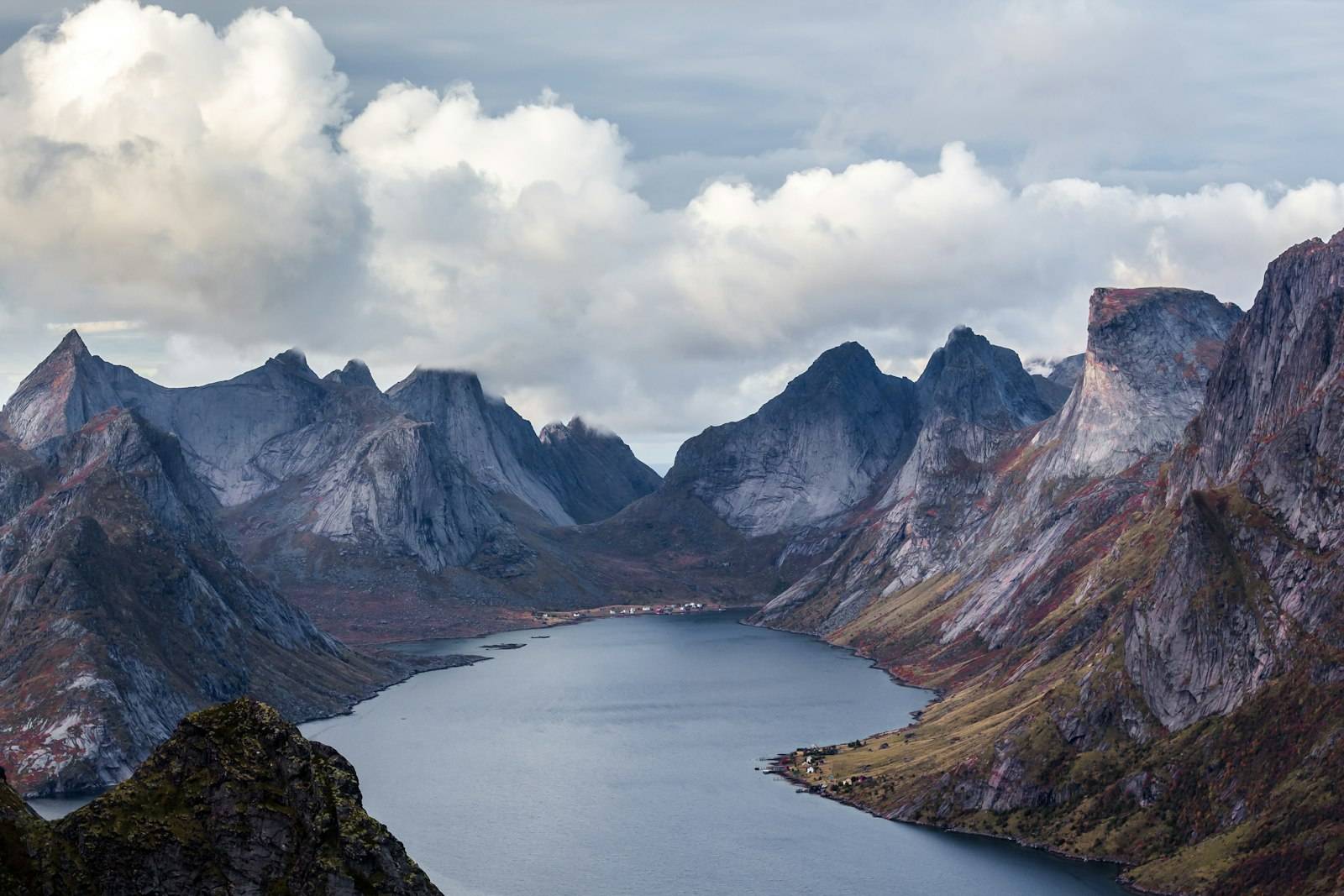
Norwegian Fjords.
Vertical cliffs dropping straight into the water, villages perched on narrow shores, and trains climbing into the clouds. This isn’t a backdrop — it’s a route that works perfectly without a car.
Vertical cliffs dropping straight into the water, villages perched on narrow shores, and trains climbing into the clouds. This isn’t a backdrop — it’s a route that works perfectly without a car.
The classic way to see the fjords — the Norway in a Nutshell route: train from Oslo to Bergen on the Bergen Line, descent by mountain railway to Flåm, and a ferry cruise through Nærøyfjord. No car needed. For those who want to reach quiet waterside villages, hiring a car unlocks extra possibilities — but that’s firmly an optional bonus.
The Bergen Line is one of the world’s most beautiful railways: seven hours from Oslo to Bergen across the Hardangervidda mountain plateau, past snowfields and hundreds of lakes. Trains run several times a day, seats are comfortable, Wi-Fi isn’t always available — but the views more than compensate. From Bergen you can head out to the fjords independently or purchase a ready-made package.
The Norway in a Nutshell route combines three modes of transport: train Oslo → Myrdal (or Bergen → Voss → Myrdal), the Flåmsbana mountain railway down to Flåm, and a ferry through Nærøyfjord to Gudvangen. Everything is timed to connect, and you can buy either a full package or each segment separately. Most travellers do it in a single day as a loop from Oslo or Bergen.
The easiest way to compare timetables and ticket prices is on an aggregator — especially when planning several segments from different cities. See also our detailed guide to trains and buses with tips on booking ahead.
Compare tickets on Omio →On the Norway in a Nutshell route — definitely not: everything runs smoothly by train, ferry and bus. A car starts to make sense when you want to reach fjord villages off the main routes — for example Eidfjord on Hardangerfjord, or small harbours along Sognefjord where the ferry calls just once a day. Your own pace, your own stops — it’s an entirely different kind of journey.
Roads along the fjords are narrow, with hairpin bends and tunnels — Norway demands a confident hand at the wheel. Bear this in mind when planning. Our car rental guide will help you navigate the terms and choose the right vehicle class.
Compare cars on Discover Cars →Norway’s most impressive fjords — Nærøyfjord and Geiranger — are UNESCO World Heritage Sites. This is where the cliffs look truly vertical and the water between them glows green. Here’s what to keep in mind when planning your itinerary:
Guided boat tours, kayak routes through the fjord and hiking trails to viewpoints are easiest to find and book in one place. See how we do it: how we choose tours.
Browse tours on GetYourGuide →One practical note: in the mountains and on the water, mobile coverage is unreliable — networks change at every tunnel. Installing an Airalo eSIM before you leave means maps, tickets and offline navigation load without any surprises.
Peak season runs from late May to early September. June and July bring the midnight sun and the maximum number of ferry sailings, but also the biggest crowds. Late May and August are slightly quieter and 15–20% cheaper. In winter the fjords are scenic, but many ferries and viewpoints are closed and mountain roads are impassable due to snow.
The classic Norway in a Nutshell fits into 1 day — the Oslo → Flåm → Gudvangen → Bergen route fills a full day. For a comfortable exploration of the fjords we recommend 3–4 days: one day on Nærøyfjord, one day in Bergen, 1–2 days on a side trip to Geiranger or Hardanger. A week-long itinerary lets you cover both UNESCO fjords and reach quiet villages.
The cheapest option — the Bergen Line train from Oslo to Bergen: tickets from €30–50 with advance booking. Timetables and prices are easiest to compare on Omio — it also shows FlixBus coaches to Oslo from other European cities. Buying each segment of Norway in a Nutshell separately, rather than as a package, is usually €20–30 cheaper.
Norway is part of the Schengen Area, so a Schengen visa covers entry. Citizens of EU countries and countries with visa-free agreements can enter without a visa for up to 90 days. Check current requirements on the Norwegian embassy website.
Norway is one of Europe’s most expensive countries: a cafe meal costs €20–35, a beer in a bar — €10–12. Savings come from: Rema 1000 and Kiwi supermarkets (ready meals from €5), booking accommodation in advance, and travelling in May or August rather than the July peak. Mobile data is cheaper with a local eSIM — via Airalo, a 10 GB Norway plan costs around €8–10.
Both fjords are UNESCO World Heritage Sites — the choice depends on your travel style. Nærøyfjord (just 250 m wide in places) creates a “living walls” effect right alongside the ferry. Geiranger is more open and spectacular, with the “Seven Sisters” and “The Suitor” waterfalls — and more touristy. If you have time — see both; if only one — Nærøyfjord is easier to reach without a car via the Norway in a Nutshell route.
For Norway in a Nutshell a car isn’t necessary — the train, Flåmsbana railway and ferry cover the entire route. A car is needed if you want to reach Geiranger independently, drive up to the Dalsnibba viewpoint, or explore Hardangerfjord and its quiet villages. Norwegian roads are narrow, with tunnels and hairpin bends — confident driving is required.
The standard one-way Oslo–Bergen package costs around €130–180 per person (train + Flåmsbana + ferry + bus). Booking each segment separately and in advance can save €20–30. A night in Bergen or Flåm adds another €80–150 for a budget hotel.
In the mountains and on the water, coverage is unreliable — Norwegian tunnels and fjords regularly swallow your signal. The most convenient option is to install an eSIM before you leave: Airalo offers Norway plans from €8 for 10 GB, activated in a minute with no physical SIM card. Downloading offline maps in Google Maps or Maps.me is worth doing in case you hit a no-signal zone.
English is perfectly sufficient. Norwegians speak English practically everywhere — in cities, villages and on public transport. Timetables, information boards and menus are always available in English as well. There are no language barriers on this route.
Maps and mobile tickets working the moment you land.
Read → 🚆Trains and buses across Europe — find the cheapest ticket.
Read → 🚗For coasts and mountain villages the trains don't reach.
Read → 🎫Skip-the-line entry tickets — best booked in advance.
Read → 🛡Peace of mind: medical cover, COVID, baggage, cancellation.
Read → ✈️The cheapest flights across Europe in one search.
Read →